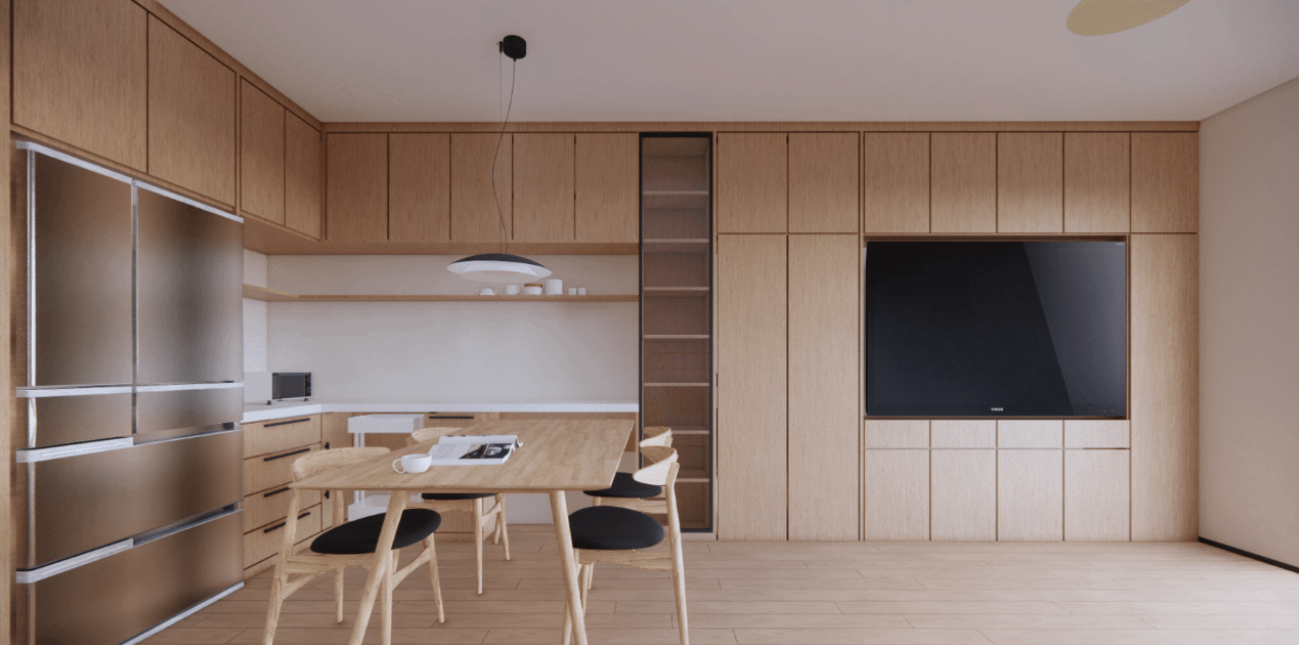
First-time home renovation enthusiasts probably share a similar experience: initial excitement, especially during furniture selection. We flip through pictures and imagine our future living space – how that Italian leather sofa would elevate our entire style; or how that solid wood dining table would become the centerpiece of our home for future birthday parties.
But to be honest, I’ve seen quite a few cases of “ideal spaces failing to come to fruition.” The furniture itself looks quite nice, but once placed in a real space, it creates an inexplicable sense of “disjointedness”—even making the overall space seem a bit…cheap.
Why is this?
Usually, the problem isn’t with the furniture itself, but rather that we focus only on individual pieces while neglecting the “flow throughout the house” and the overall visual language. A truly sophisticated home isn’t defined by a single expensive piece of furniture, but rather by all areas—from the entryway cabinet and the main sofa in the living room to the hidden transition areas—”dialogue” with the same aesthetic logic.
This includes aspects we often overlook, such as the style and design of modern bathroom spaces , which actually need to complement the soft furnishings and material selection in the living room. Only when this “weakly related yet unified” connection is established between the hard furnishings and soft furnishings, and between dry and wet areas, will your home present a naturally sophisticated feel, rather than a showroom crammed with individual items.
Next, let’s try to move beyond the idea of “choosing a piece of furniture” and talk about how to achieve a truly unified style throughout the house from a more comprehensive perspective.
Style definition: Why do your furniture and interior design always seem to clash?
The biggest pitfall in home renovation is sometimes not the budget, but the “mix and match” approach. Many people’s favorite furniture styles are simply incompatible with the existing hard furnishings in their homes.
For example, in a space with cool gray floor tiles and a minimalist design without a main light, suddenly stuffing in a set of carved American retro beds… that kind of visual conflict can really make people feel inexplicably nervous.
Therefore, before purchasing any large pieces of furniture, I strongly recommend that you take a look back at the overall color scheme of your home. Especially the classic 60-30-10 rule, which is truly a “foolproof formula” in the decorating world:
60% Main color scheme (walls, floors): Determines the warm or cool tone.
30% secondary colors (large furniture pieces): sofas, cabinets, and dining tables are all in this section.
10% Accent Colors (Soft Furnishings and Accessories): Cushions, wall art, and vases brighten up the space.
Once the colors are stable, the style won’t go astray.

Living room: The “anchor point” of the whole house’s style; choosing the right furniture ensures the whole house stays on track.
The living room is truly the “face” of a home and the starting point for all spatial styles. You could even think of it as: the living room is the central theme, and the bedrooms, dining room, and even the bathroom are extensions of it.
1. Sofas and coffee tables: More than just seating, they are sources of style.
The sofa occupies the largest visual area in the living room. If you prefer a modern minimalist style, choosing a sofa with clean lines and soft colors is always a safe bet.
Neutral colors like off-white, light gray, and earth tones are not only pleasing to the eye, but also blend naturally with various hard furnishing materials (wood veneer, large slab tiles, micro-cement).
2. Cabinet furniture: Storage is the underlying logic of aesthetics.
Whether a space is messy or not is less a matter of aesthetics and more a matter of whether its “storage structure” is reasonable.
For example, when designing TV cabinets and sideboards, my usual principle is to conceal eight parts and expose two .
The surface material of the cabinet is also extremely important: walnut wood, oak, and lacquered panels are themselves “anchor points for the style of the whole house”.
If your living room TV cabinet is made of black walnut, it’s advisable to incorporate a similar wood grain in one or two other spaces (even the bathroom). This subconsciously creates a sense of “coherence” throughout the home.

From dry to wet areas: How to make materials, color temperature and details echo each other throughout the house?
Honestly, this is an “advanced technique” that many people have no idea about when decorating for the first time.
Why do the spaces in a five-star hotel always feel comfortable no matter where you go?
Because the design elements are consistent throughout the entire space, and the style doesn’t suddenly change when you enter the bathroom.
A spatial echo between metal and wood
If your living room coffee table uses brass components, or your light fixtures are matte black, then try to extend that design to the bathroom as well.
Faucet
Towel bar
Shower enclosure frame
Simply unifying the finish to brushed gold or matte black will significantly enhance the overall quality.
Wood grain continuity: subtle, yet effective.
For example,
if the bedside table is made of white oak, then choose a similar wood grain color for the bathroom vanity door.
It’s not a “copy,” but a “weak association.” This subtle unity elevates the quality of a space more than you might imagine.
Uniformity of light color temperature
The most disjointed aspect in many homes is actually the lighting.
Warm white light (3500K) in the living room creates an atmosphere, but if the light suddenly turns to cool white light (6000K) in the hallway or bathroom, the atmosphere immediately breaks down.
Maintaining a consistent color temperature allows for a more natural flow in a space.
Furniture Checklist to Enhance Your Home Life
While a unified style is important, a home is ultimately for living in. Here are some practical and stylish furniture tips:
• Single lounge chair
It can be placed in a corner of the living room or on the balcony. Choosing a pop of color (orange, dark blue, forest green) can make the space more vibrant.
• Movable side table
It’s incredibly versatile—you can place it next to the sofa when you’re drinking coffee, move it to the bedside when you’re reading, or even put it next to the bathtub when you’re taking a bath.
• Multi-functional chest of drawers
With its moderate height and considerable capacity, it can serve as a display table in the entryway or add storage. Simply place some greenery or aromatherapy items on top, and the space will instantly feel more inviting.
Conclusion
A home is not a patchwork of rooms, but a complete, breathing whole.
The next time you’re debating whether to buy that expensive dining table, try putting it within the overall framework of your home. Does it match the wood grain of the living room, the metal fixtures in the bathroom, the color temperature of the entire house, and the rhythm of the soft furnishings? If the answer is yes, then it’s the right choice.
Interior design is an art of choices, styles, materials, and lifestyle. Hopefully, this guide will help you avoid pitfalls throughout the process and gradually build your own ideal living space.